Constant Grid collapse: Why Distributed Generation is the future of Nigeria’s energy Needs.

Constant Grid collapse: Why Distributed Generation is the future of Nigeria’s energy Needs.
Introduction
Think about these things: Every time Nigeria’s National grid collapses, millions of people are thrown into darkness, Businesses suffer great losses, and the economy loses billions of naira. These recurrent collapses of the nation’s power grid are not just technical glitches, but a manifestation of the rot in the nation’s power system.
The Solution to the incessant power grid collapse lies in the country embracing a Distributed (Embedded) Generation power system, to power districts, states, and regions, as this would help reduce the existing pressure on the current central power system and also improve the system’s overall reliability.
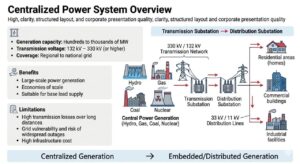
Nigeria’s National power grid has recently experienced frequent collapses, plunging the entire nation into darkness, causing enormous economic losses running into billions of naira, and increasing dependence on private generators. As of March 2026, the national grid has recorded at least six major grid collapses since 2025, with some sources suggesting even higher figures. The country currently operates the central power system. In the central power system, where Power is first generated at about 11kV, transmitted over a long distance, at a higher voltage of 132KV-330KV, and finally stepped down to 33KV for distribution purposes, and 415V for delivery to homes. See the diagram below.
Electricity is pivotal to any economic growth, industrial development, and social rejuvenation. Despite its importance to socio-economic growth and development, Nigeria seems not to have found a permanent solution to its frequent grid collapse and its poor transmission system.
Available data shows that during the return of democratic government, the government at that time invested billions of dollars in trying to fix the nation’s poor power system. However, due to poor planning and corruption, the dream of fixing the nation’s power system remains a mirage and continues to be a tall dream.
As of March 2026, the total generation installed capacity is about 13,623MW, and the average available capacity is about 4,384-4,400MW, which is supposed to be an improvement on paper as against what it used to be before 1999.
The failure in identifying the real Solution to Nigeria’s Electricity Challenge.
As I stated earlier, between 1999 and 2007, the government at that time spent well over 20 billion dollars trying to fix the nation’s power needs. However, I must confess that due diligence was not properly followed, both in the process of contract awards and in identifying the real problem in the power industry (problem analysis). The major stakeholders in the power industries were also not adequately consulted before the design and siting of power plants.
Gas turbines were sited largely for political considerations, with installations in areas where gas supplies were largely absent. Also, in some other areas where gas turbines were located close to gas supply, there were no visible plans on how to transmit the generated power from the generating plants.
Nigeria’s power system operates largely on a centralized electricity system, consisting of three main sectors, namely: generation, which is now made up of the generation companies, also known as the “GenCos”; transmission, which is managed by the Transmission Company of Nigeria (TCN); and distribution, which is managed by several distribution companies, also known as the “DisCos”.
Using the above centralized model, electricity is generated at large generating stations like the Kinji Dam, Shiroro Dam, Egbin power plant, etc. It is then transmitted over very long distances (several thousand kilometers) across the country, mostly via 330KV and 110KV transmission lines. The system is monitored by a few monitoring and coordinating stations, also known as the National Control Centers (NCC), such as the one in Osogbo, Osun state, managed by the Transmission Company of Nigeria. There are also other control centers located in Shiroro, Ikeja, and Benin, which serve as backup centers to the main NCC.
The Nigerian current Power system resembles a “goblet” wine cup, with a wide top and bottom and supported by a narrow stem. While investments were made between 1999 and 2007 for the construction of new generating stations in the country, another set of investments was also awarded for the expansion of the Distribution system, leaving out the transmission system, the critical link, thereby creating a bottleneck in the system, which, ab initio, was poorly designed.
It only dawned on the planners, after the construction of a sizeable number of generating plants which increased the generating capacity from about 3500MW to about 13,600MW, that the power generated could not be transmitted to their planned locations. In addition, the total installed transmission capacity is not only below the total required capacity, but the system has also become weak, and the system control and protection system need an upgrade.
Studies shows that between 2010 to 2013, that siemens were engaged to upgrade some of the protection systems across the country. It is not enough to install protective relays; the whole system needs an urgent upgrade.
At this point, I must say that following available data’s and researches, conducted over the years. The current power network system in Nigeria, from generation to Transmission and then distribution, is no longer fashionable and is becoming outdated in relation to today’s demand and technologies.
Reasons why we have to move away from the current power setup:
- Aging infrastructure: Most of our Transmission lines and substations are outdated, and the equipment is not designed for the current load demand. This has led to frequent grid failures, high transmission losses, and poor network reliability.
- The current structure does not fully support decentralization of the system.
- The system does not support the integration of more modern generation to the distribution system, also known as distribution generation. Without an advanced control and protection system, the grid becomes very unstable, and the power quality of the system deteriorates.
- The Cost of building and upgrading the transmission system would be too expensive, and such an amount could build several Distribution generation systems across the country.
- The country lacks modern smart grid Infrastructure: Today’s modern grids make use of Real-time monitoring, automation, AI, and self-healing. Nigeria’s grid system still makes use of SCADA coverage and, in some cases, manual intervention. This leads to slow fault detection and fault response; It is also responsible for poor system visibility.
- Centralized Grid system is no longer sustainable for several reasons, such as the cost of building generating, transmission, and distribution systems across the country. The reliability of this system, given our current transmission network, is unreliable.
Distribution Generation: A Solution to Nigeria’s Power System Challenges.
Nigeria is a nation that is richly endowed with oil and gas, which are found in abundance in the southern part of the country. In contrast, the Northern parts of the country have abundant Solar radiation. Coal can be found in abundance in Enugu, Nasarawa, and Kogi states. Waterfalls in several locations across the country, and wind energy is available in all parts of the country, but the country is still unable to utilize this gift of nature to its advantage.
The current power Generation capacity for a nation with over 200 million people is not only inadequate but also a sign that the nation wishes to continue operating in muddy waters, where systemic inefficiencies and policy inconsistencies continue to slow major progress.
Distributed generation is relatively a new term compared to the centralized Generating system. DG has become the center of attraction in most countries. Day by day, its usage in distribution networks is on the rise. DG is often associated with renewable energy, which helps lower environmental impact. DG is often associated with the standalone system.
However, DG refers to small or medium generation systems that are connected to the Distribution network (415V or 11-33kV), to supply power locally and operate in either grid-connected or standalone mode, like the Dangote refinery and several other factories generating their own power.
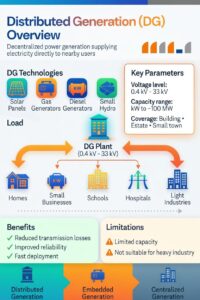
The use of DG reduces dependence on long-distance transmission by localizing power generation and distribution to nearby load centers.
The International Council on Large Electricity Systems (CIGRE) defines DG as generation that is not centrally planned, centrally dispatched at present, usually connected to the distributed network, and smaller than 50-100MW.
Countries like the United States, China, India, and many European countries have since adopted this system of power generation and distribution.
China leads the world in the total installed Distributed Generation in the world with a capacity of 488GW, followed by the United States with a capacity of 200-250GW, and then India with an installed capacity of 70-90GW.
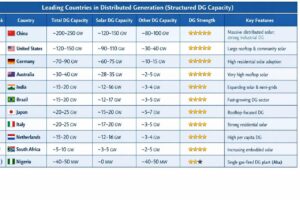
Nigeria is far behind in the use of this technology. In the 1970’s -1980’s, NESCO supplied Power to Jos and its environs, though this power plant was constructed pre-independence, but the government did little or nothing to encourage such an independent setup, that is independent of the National grid. In recent times, only the integrated power plant in ABA is connected to the 33KV grid. The DG system can also be integrated such that distribution to neighboring towns can be done using a 33kV line (Inter-town distribution network (ITDN)), without the use of Transmission lines.
A DG is designed to serve localized loads, towns, and industrial layouts at a medium-voltage level of 33KV or a low-voltage level of 415V. A lot of people only liken DG to “rooftop solar panels’, DG is broader than rooftop solar panels.
Key Policy Recommendation:
(i) Regulatory reform:
• Encouraging private sector participation
• Introduction of valid and technical laws that will guide the establishment and connection guidelines.
(ii) Market Mechanism
• Encourage energy trading at the distribution level.
• Introduce a metering system to determine how much energy grid-connected users are sending to the grid. Reward systems like tax breaks can be introduced to encourage more individuals to sell their excess power to the grid.
(iii) Infrastructure Modernization
• The distribution network should be upgraded for the purpose of DG network.
• The deployment of smart grid technologies for real-time monitoring, control systems, and for fault detection and protection
(iv) Investment and funding
• Create special-purpose funding programs
• Encourage the participation of public-private partnerships (PPP)
• Facilitate funding from financial institutions like the World Bank and the African Development Bank.
(v) Establish implementation strategy, such as:
Phase 1-short term 1-2 years
Phase 2-Medium-term:3-5years
Phase 3-Long-term:5-10years
Common DG Technology:
- Solar Photovoltaic System:
- Wind Energy-Wind turbines
- Bioenergy or Biogas
- Mini-hydro power plants
- Fuel cell
- Mini-hydro power plant
- Geothermal Energy.
From the table above, the solar photovoltaic system is the most widely used in most countries. It’s cheaper to install than the others and has no running costs beyond the initial installation cost. Some countries, like the United States, have fully adopted this system and even encourage their citizens to sell their excess generation to the grid.
Nigeria needs to adopt this system if it has to overcome the current epileptic power supply. This can be achieved if the government licenses companies and individuals to generate power and sell it to the grid. This will help take off the current burden on the already weak national grid.
DG has numerous advantages for a developing country like Nigeria, and in terms of reliability, it has a higher percentage than the centralized system. The DG system can function as: a standalone system; a standby system; or be used for rural and remote applications and peak load shaving.
Effective Power generation and distribution remain the key panacea to move Nigeria from its current economic woes to a prosperous nation, as it would lead to massive industrialization. Relying on an overstretched and fragile grid network will continue to spell doom for the nation. The future of the nation’s power system lies in the government intervening in enacting policies, funding massive construction, creating an enabling environment for private sectors, for decentralization of the power system across the nation.
Written by
Engr. Iro Chidi (MNSE, NEMSA “A”, PMP, ACP, RMP…)
Electrical Engineer/Project Management Consultant
Doctoral Researcher-Electrical Power System